Property Maintenance Guide — Yorkshire
Gutters and downpipes do one job: carry rainwater off your roof and away from your property. When they stop doing that job properly, the consequences can be slow to appear but expensive to fix. This guide explains the warning signs, the common problems, what gutter repair and cleaning involves, and how to keep on top of it as a Yorkshire property owner.
Contents
Why gutters matter in Yorkshire
Yorkshire receives above-average rainfall compared to much of England, and the region’s varied terrain — from exposed moorland edges to dense urban areas — means properties face a fairly demanding weather environment throughout the year. Gutters and downpipes are the first line of defence against that water.
A functioning gutter system channels rainwater from the roof into the downpipes and from there into drains. When that system is clear and well-maintained, your roof, walls, and foundations stay dry. When it isn’t, water has to go somewhere — and it usually finds the least convenient route possible.
The problem is that gutters tend to fail gradually. There’s rarely a dramatic moment where everything suddenly stops working. Instead, it’s slow blockages, minor leaks at joints, a section that starts to sag slightly under the weight of debris. By the time the consequences become obvious — damp patches on interior walls, staining on the fascia board, water pooling near the foundations — the damage has often been accumulating for a while.
How Yorkshire’s climate affects gutters
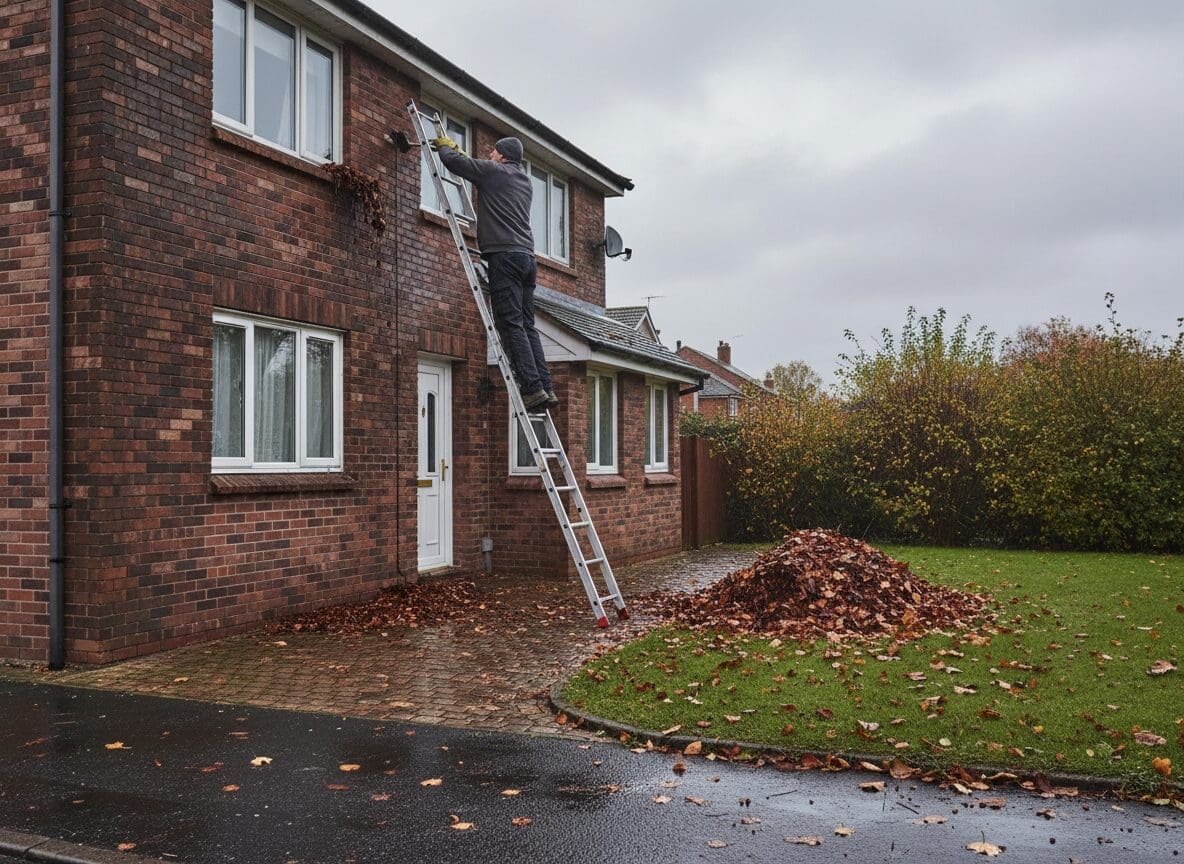
Autumn is the hardest season on gutters in Yorkshire. Falling leaves from trees — particularly in suburban areas of Sheffield, Leeds, and Harrogate — quickly fill sections that might otherwise remain clear. Moss and lichen growth from damp summers can also deposit debris into gutter channels over time.
Winter brings its own challenges. Water that sits in blocked or sagging gutters freezes in cold snaps, expanding as it does so and putting stress on joints and brackets. The freeze-thaw cycle over a Yorkshire winter can accelerate the deterioration of an already-compromised gutter system significantly.
Warning signs your gutters need attention
Most gutter problems give you advance warning before they cause serious damage. The key is knowing what to look for.
During or after heavy rain
- Water overflowing at a specific point — usually indicates a blockage just before that section. Water backs up and spills over the edge rather than running along the gutter to the downpipe.
- Water dripping from a gutter joint or seam — the sealant at joints breaks down over time, particularly on older uPVC systems.
- A downpipe that isn’t running — if water is clearly coming off the roof but the downpipe appears dry, there’s likely a blockage somewhere in the pipe itself.
- Water running down the wall rather than into the downpipe — the downpipe may have detached from the wall or the outlet from the gutter may be blocked.
From the ground
- Visible sagging — a gutter section that has dropped away from its correct alignment, often caused by a bracket that has failed or come loose.
- Plants or moss growing in the gutter — a clear sign of debris accumulation. Seeds land in a blocked, debris-filled gutter and germinate. Left unchecked, root growth can damage the gutter itself.
- Staining on the wall below the gutter line — dark streaking on render, brick, or painted surfaces suggests water has been running where it shouldn’t be.
- Rust marks on older cast-iron gutters — though many older properties in Yorkshire still have cast-iron systems, rust is a sign the material is deteriorating and needs treatment or replacement.
Inside the property
- Damp patches on internal walls — particularly in upper-storey rooms adjacent to exterior walls. This can have several causes, but persistent gutter overflow is one of them.
- Damp or water ingress in the loft — water finding its way under the fascia or into the eaves space.
- Staining around window frames — if a blocked gutter is causing overflow directly above a window, water will eventually find its way into the frame.
What happens when gutters are left too long
Gutters that aren’t maintained eventually cause damage to parts of the property that are much more expensive to repair. Understanding the chain of events helps explain why regular gutter maintenance is worthwhile.
Fascia board damage
The fascia board — the horizontal board the gutter is fixed to — is typically timber on older properties and uPVC on newer ones. When a gutter overflows consistently, water soaks into timber fascias, causing them to rot. Once a fascia board is significantly rotted, it can no longer support the gutter properly, which accelerates the failure of the gutter system itself. Replacing fascia boards is considerably more involved than clearing a gutter.
Damp penetration into the wall
Yorkshire’s older housing stock — particularly Victorian and Edwardian terraces — often has solid brick walls rather than cavity walls. Solid brick is more susceptible to damp penetration from persistent water exposure. A gutter that has been overflowing onto a solid brick wall for a year or two can cause internal damp that takes considerable remediation to address properly.
Foundation and ground-level damage
A blocked downpipe that is directing water at the base of the property rather than into a drain can cause soil saturation near the foundations. Over time, this leads to ground movement and in severe cases contributes to subsidence risk — though this is more of a concern with prolonged neglect than a single season of blocked gutters.
Roof and eaves damage
Water that can’t drain away properly can back up under the lowest courses of roof tiles in freezing conditions, causing damage to the tile bedding and the battens beneath. In older properties with lead or mortar flashings, this water ingress can also affect the seal between the roof and the chimney or dormer.
Types of gutter problems we fix
We Fix Yorkshire handles the full range of gutter and downpipe issues across Yorkshire and North Lincolnshire. The most common jobs we’re called to deal with include:
| Problem | Typical cause | Usual fix |
|---|---|---|
| Blocked gutters | Leaf and debris accumulation | Clear and flush, check outlet |
| Blocked downpipe | Debris compacted in the pipe | Rod or flush through, clear blockage |
| Leaking joint | Failed sealant or clip | Reseal joint or replace union piece |
| Sagging section | Failed or loose bracket | Replace bracket, re-align section |
| Cracked or split gutter | Age, frost damage, impact | Section replacement |
| Detached downpipe | Failed fixings or bracket | Re-fix bracket, resecure pipe |
| Overflowing at outlet | Blocked outlet or undersized outlet | Clear outlet, assess capacity |
| Rusted cast-iron gutters | Age and moisture exposure | Treatment or replacement depending on extent |
Where gutter issues are associated with roofing problems — damaged tiles, failing flashings, or fascia rot — we can assess both at the same time and advise on the most sensible order of repairs.
What gutter repair and cleaning involves
Understanding what a gutter service actually involves helps set realistic expectations for what we’ll do and how long it takes.
Gutter clearing and cleaning
This involves removing debris from the gutter channels — leaves, moss, compacted material, and any plants that have started to grow. We then check the outlets and the top of each downpipe to make sure nothing is causing a partial blockage. Downpipes are flushed to confirm water flows freely from the gutter through to the drain at ground level.
For a typical semi-detached or terraced property, this usually takes two to three hours. Larger detached properties, particularly those with multiple roof levels or complex gutter runs, will take longer. Access requirements vary depending on the height of the building — ladders are sufficient for most two-storey properties, but taller or more complex buildings may need additional equipment.
Gutter repairs
Repairs are usually carried out at the same time as a clearing visit if the issues are identified during the service. For leaking joints, we remove the section, clean the sealing surfaces, and apply fresh sealant before reassembling. Bracket replacement involves removing the failed bracket and fitting a new one at the correct alignment and fall to ensure water runs toward the downpipe.
Section replacements — where a length of gutter is cracked, broken, or too far deteriorated to repair — require matching the existing gutter profile and colour. Most modern uPVC guttering is in standard sizes, but older or unusual profiles can sometimes be more involved to source.
What we check while we’re there
When we’re working on gutters, we also make a point of noting the condition of the fascia boards, soffits, and the visible sections of roof at eaves level. If we spot anything that looks like it needs attention — a damaged tile, a loose lead flashing, a section of fascia that’s starting to soften — we’ll let you know so you can decide whether to address it.
Maintaining gutters between service visits
A professional gutter clear once or twice a year is the most practical maintenance for most properties. But there are a few things you can do to help keep on top of things between visits.
Know your property’s risk factors
Properties with overhanging trees — particularly in autumn — will fill up faster than those without. If you have mature trees directly adjacent to the property, you may need a clear in November after the leaves have fully fallen rather than relying on a summer visit alone.
Watch for the early signs
After heavy rain, take a few minutes to observe your gutters from the ground. Water overflowing at a specific point, or no water coming out of the downpipe at all, is a reliable indicator that something needs attention before the problem develops.
Don’t ignore small leaks
A weeping joint that you notice in September may seem manageable. By January, after freeze-thaw cycles have worked on it, the same joint can have opened significantly. Small repairs dealt with promptly are always cheaper than the same problem left to develop.
If you’re unsure about the condition of your gutters, or if you have a problem that needs assessing, contact We Fix Yorkshire and we’ll arrange to take a look. We cover gutter maintenance and roofing and guttering services across Sheffield, Leeds, Rotherham, Doncaster, Hull, York, Scunthorpe, and the wider Yorkshire and North Lincolnshire area.
Gutter problems in Yorkshire? We can help.
We Fix Yorkshire handles gutter clearing, repairs, and full gutter system replacements across Yorkshire and North Lincolnshire. Call 0330 133 3463 or request a quote online.
Frequently Asked Questions
How often should gutters be cleaned in Yorkshire?
For most properties, once a year — typically in late autumn after leaves have fallen — is a practical minimum. Properties with overhanging trees, or those that have had persistent problems in the past, benefit from a second visit in spring to clear any debris that has accumulated over winter.
Can you repair gutters without replacing them?
In most cases, yes. Leaking joints, failed brackets, and minor cracks can often be repaired without replacing entire sections. Where a section is too deteriorated to repair reliably — particularly on older cast-iron systems — we’ll advise on replacement as the more cost-effective long-term option.
Do you replace cast-iron gutters with uPVC?
We can replace cast-iron with uPVC where appropriate. On some older properties — particularly in conservation areas — there may be restrictions on what materials can be used. We’ll advise on this when we assess the job.
How do I know if my downpipe is blocked rather than the gutter?
If the gutters are overflowing at the downpipe outlet rather than along the channel, the blockage is likely in the pipe itself. Signs include: the gutter filling up and overflowing at the point where it meets the downpipe, or no water appearing at the bottom of the downpipe during rain. We can confirm this and clear the blockage when we visit.
Do you cover emergency gutter or roof repairs?
Yes. If you have an urgent problem — a detached downpipe causing flooding, or a gutter failure after storm damage — contact us and we’ll do our best to prioritise your call. See our emergency reactive maintenance service for more information.
If your gutters are pulling away or sagging at the fixings, the problem is often with the fascia board behind them rather than the guttering itself. Our guide to fascia and soffit replacement in Yorkshire covers what’s involved, typical costs for 2026, and what to expect on the day.